Vision + RL · ICM-CSIC × UPC 2025 — present
Camera-only localization of small floating buoys
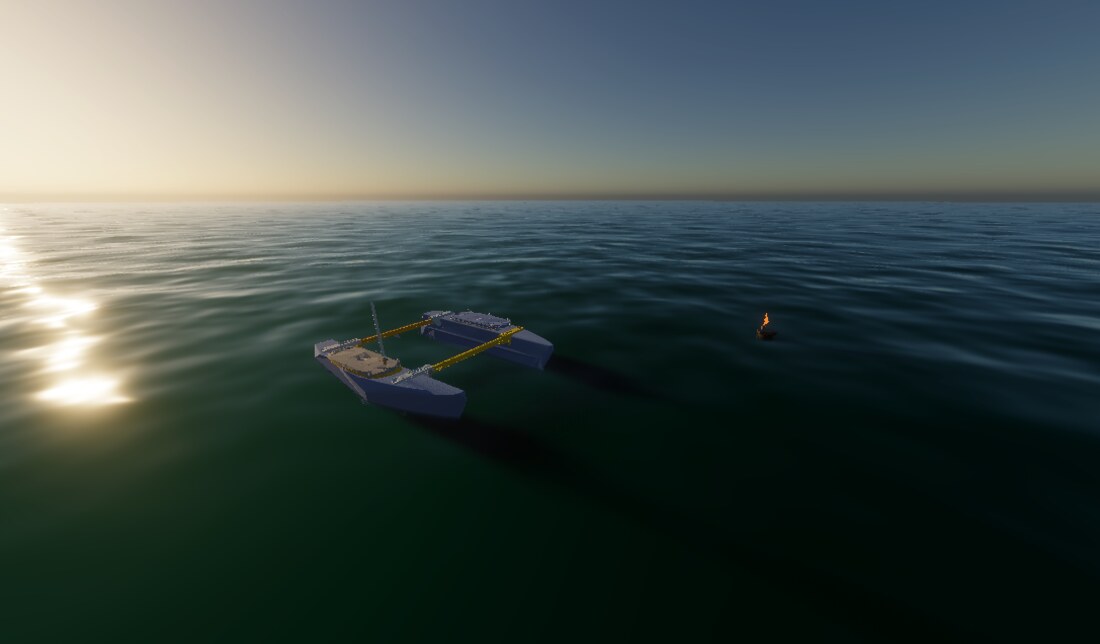
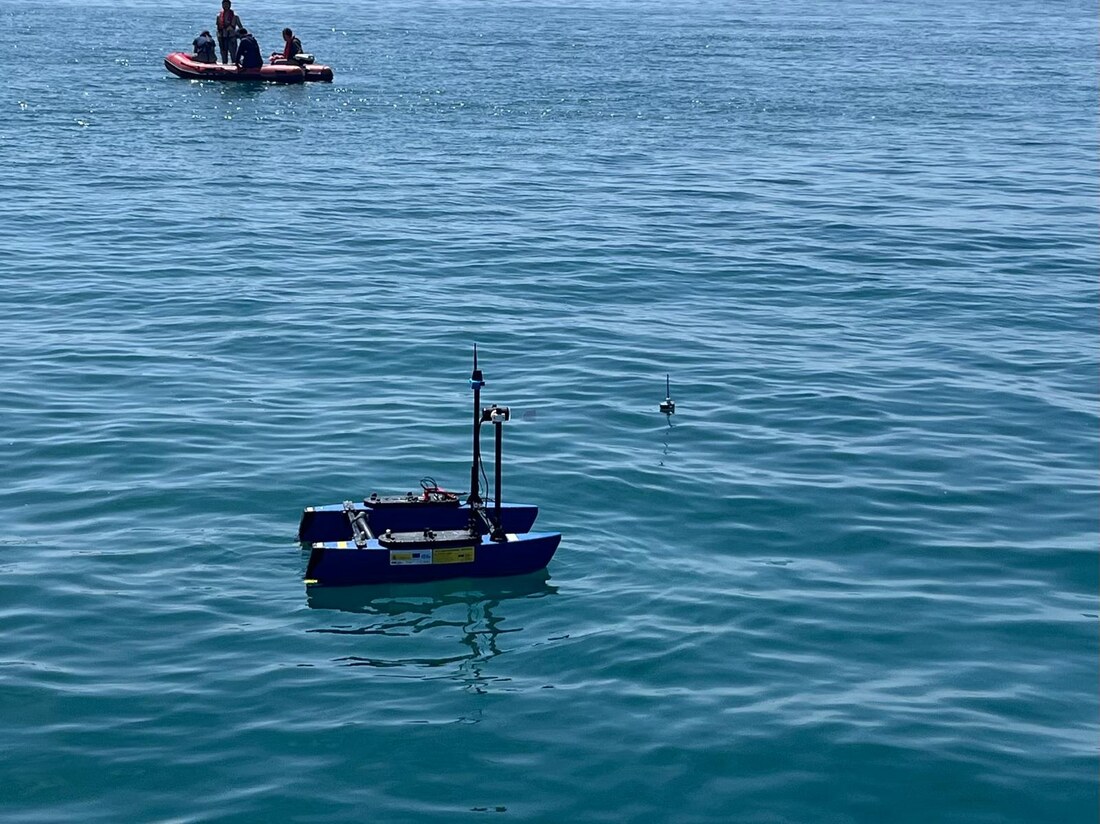
A simulation-to-reality pipeline for training an autonomous surface vehicle — a BlueBoat by Blue Robotics — to visually find small monitoring buoys in realistic marine conditions. Unity HDRP synthetic data generation feeds a YOLO detector, paired with PPO-based reinforcement learning — with curiosity and LSTM memory — to learn efficient search behavior. Trained RL policies working in conjunction with YOLO have already been successfully validated on the real platform.
Results § measured
Real-world validation
The detection model has been validated in real scenarios: trained on synthetic imagery, it reliably detects buoys from the BlueBoat's onboard camera in open water.
Search performance
The learned policy matched the success rate of a tuned Archimedean-spiral baseline while detecting the buoy 22.7% faster.
Engineering contribution
Validated automatic synthetic dataset generation, exploration-driven reward shaping, and systematic learned-vs-classical evaluation.
Sim to real § same boat, two worlds
Why it matters § scope
Autonomous marine monitoring
Fast localization of floating monitoring equipment when GPS cues are coarse or intermittent — a recurring need for ocean observatories and instrument recovery.
Reusable methodology
The same pipeline adapts to related search scenarios with different targets and sensing constraints, backed by a purpose-built high-fidelity simulator for sim-to-real robustness.